in the cottonwoods signals the presence of a woodpecker.
Male “Red-shafted” Northern Flicker (Colaptes auratus).
in the cottonwoods signals the presence of a woodpecker.

Male “Red-shafted” Northern Flicker (Colaptes auratus).
of the incredible landscape of Castle Valley National Park is nothing less than spectacular on an equally spectacular afternoon.

in Castle Valley National Park. The singletrack beckons.

occurs once a month on the Utah - Colorado state line, here framed by the Book Cliffs to the north. The so-called Warp Core chapter of the National Association of Rocketry organizes model rocket launches at this remote site where members fly low-, medium- and high-powered model rockets. It’s a ridiculous amount of fun and here are some of my launches from today.

The launch site in the Grand Valley west of Grand Junction, Colorado. NOTAMs are filed and we have a waiver to fly to 12,000 feet (4,000 meters). Coordinates: 39.27910365938015, -109.04074725724564

The scale model Doorknob sounding rocket moments after ignition.

Cherokee Pro roaring off the rail on a G40-7W engine to an apogee of 1,711 feet (522 meters).

The recently finished (but not yet painted/decaled) Bull Pup on its maiden flight skyward on a F20-4W engine.
absolutely demands a rocket launch. Willing to comply, Nike X achieved a 576 foot (176 meter) apogee on a “C” engine on a 48 second-long flight.

Nike X and me. The Aerotech wireless launch controller seen attached to the tripod works fantastically well, allowing a greater standoff from the pad, using Bluetooth and your smartyphone.
is ripping apart the dawn skies as the tail end of a small winter storm passes through the region.

highlights the eastern skyline at dusk.

lends itself to an Ansel Adams-y image.

despite the recent snow and rainstorms that passed through the region.

A view of the high country with its fresh mantle of snow.

We’re only half-way to an “average” snowpack but there are still 46 days until the typical peak.
greets the breakfast visitors at the feeding stations this morning.

Western Meadowlark (Sturnella neglecta).

enjoys a diverse diet during this dry winter, caught here through the front window at dusk.

Mule deer (Odocoileus hemionus) browsing on sagebrush.

Smoking a honey locust seed pod.
herald a big change in the weather pattern for southern Utah the week ahead.
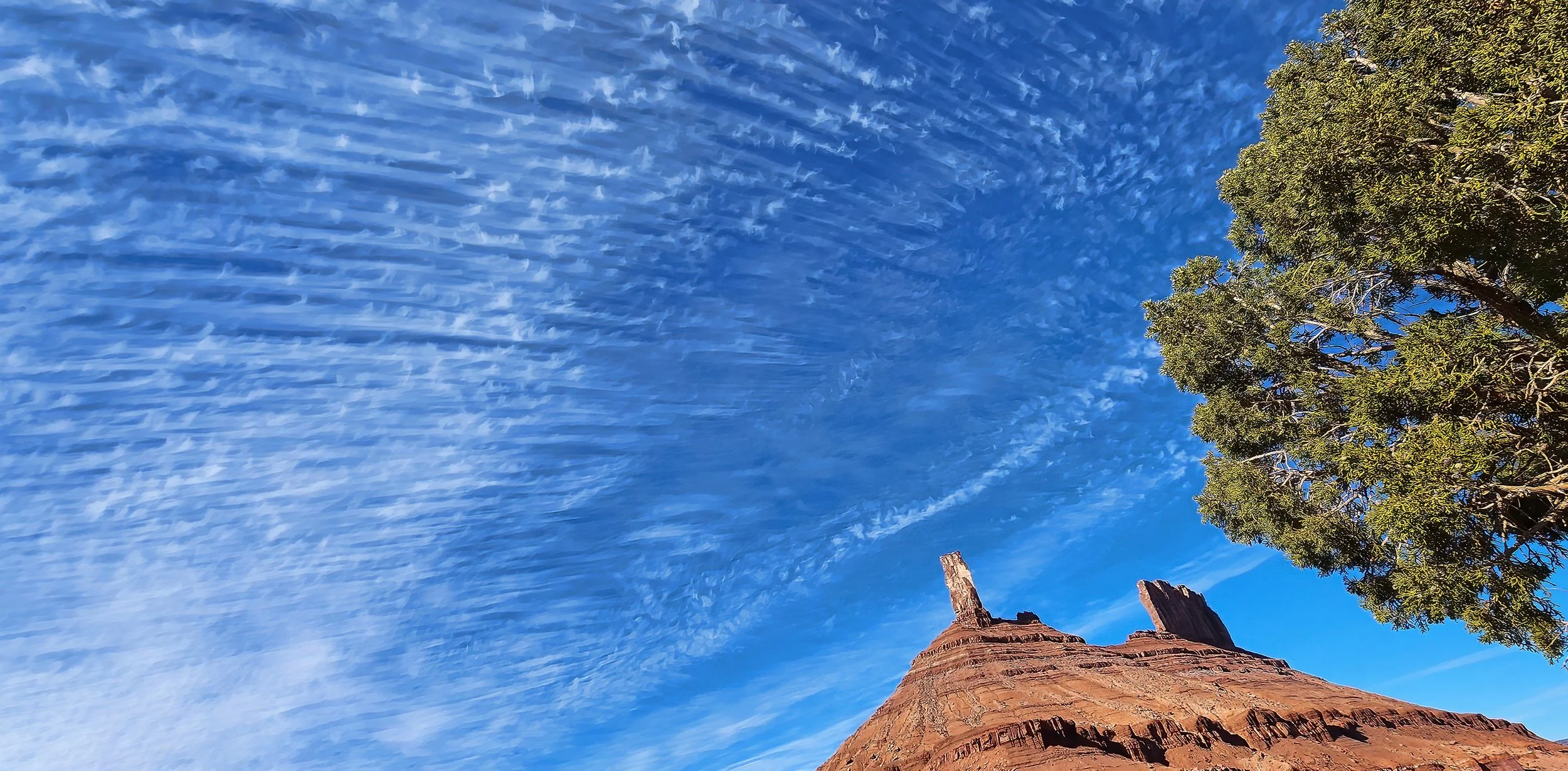
Cirrus uncinus clouds above Castleton Tower.
while its head turns on a swivel, Sharpie visits at dusk.

Sharp-shinned Hawk (Accipiter striatus).
as a small flock of jays noisily announced their presence this morning.

Pinyon Jay (Gymnorhinus cyanocephalus).

at the stratigraphic contact between the Cutler and Moenkopi Formations below Adobe Mesa bears some further examination, but it’s a difficult scramble to its location on steep and unstable slopes. Light-colored mineral deposits, likely either calcium carbonate (calcite) or calcium sulfate (gypsum), occur at the margins of the seep.


to only about 70% of median snow water content in the La Sal Mountains as this very dry winter season continues.

Wind-swept rocky surfaces and large snow cornices reveal a high country that hasn’t seen significant snowfall since around Thanksgiving.

of Sevenmile Canyon north of Moab on a spectacular mid-winter day.

An immense pour-off defines the upstream end of Sevenmile Canyon, west of Arches National Park.

The Slick Rock Member of the Entrada Sandstone comprises the vertical walls of Sevenmile Canyon, capped by the Moab Member of the Curtis Formation (Middle Jurassic (174.1-163.5 Ma)). The Windows Section in Arches National Park on the horizon is eight miles (~13 km) distant.
and in with the new as the seldom-used and decrepit corral along Castleton Road is demolished and replaced with metal fencing.

on the hardtail during today’s gloriously nice ride. This also pushes me past 60% of the distance around the Earth at the equator.

with infinite patience at the feeding station this cold and overcast morning, Sharpie sat nearly motionless for about 45 minutes.

Sharp-shinned Hawk (Accipiter striatus).