magnificently glorious autumn days.
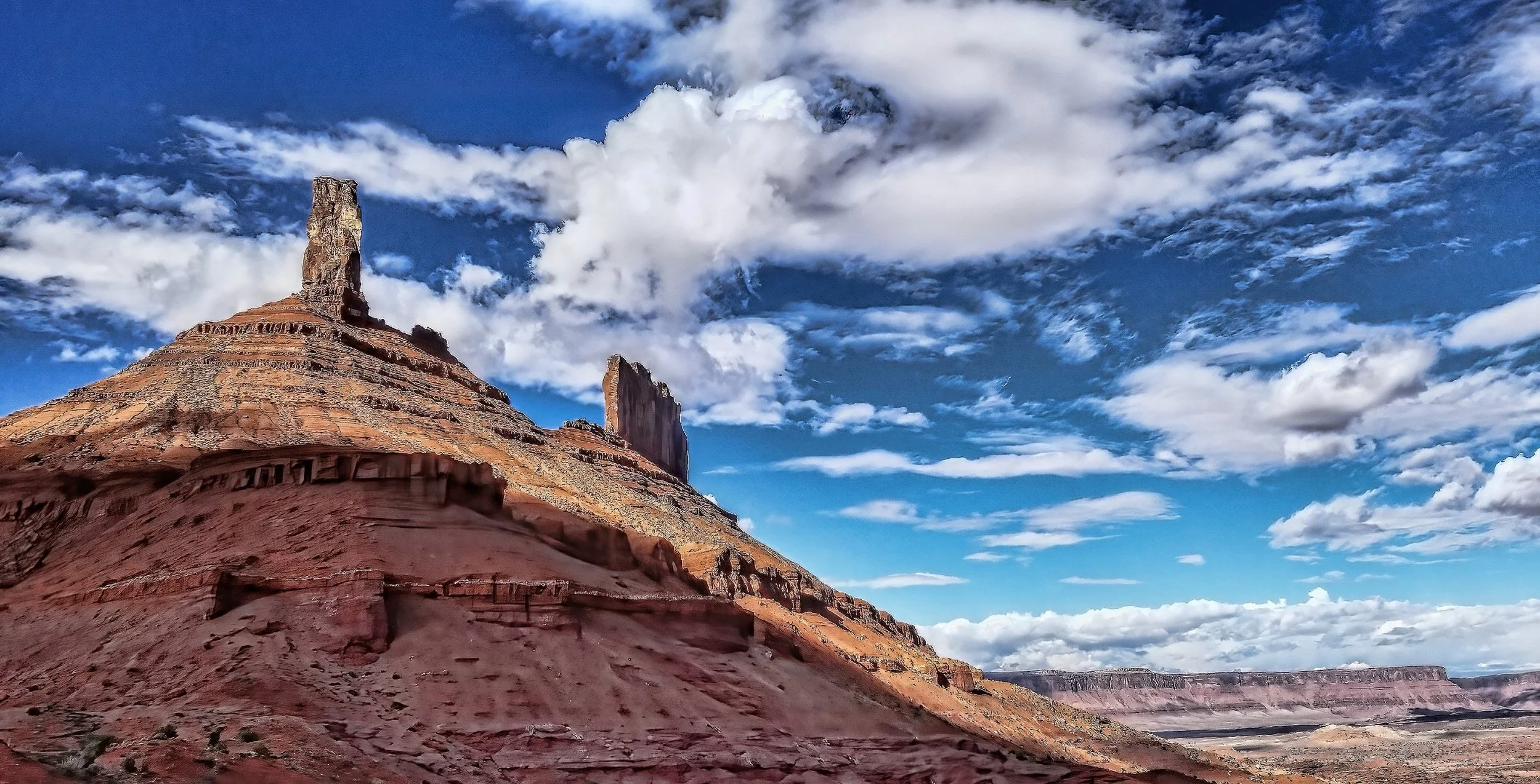
Trace fossils...
belonging to the Scoyenia ichnofacies seen on the underside of this sandstone slab, consisting of the casts of tracks/trails and shallow horizontal burrows in the Permian-age Cutler Formation in Castle Valley, Utah. I’m coming back for this on a sample return mission on my eMTB tomorrow.


UPDATE: Grabbed the nice specimen this afternoon, and now it’s in the rock garden.
Sweeping view of Porcupine Rim...
along the axis of Castle Valley, from the high La Sal Mountains to Parriott Mesa, from the tiny town of Castleton (far distant left) to the community of Castle Valley (far distant right).
Click on image to enlarge.

View south toward Round Mountain, with the tip of Adobe Mesa in the upper left.

View toward the northwest showing the town of Castle Valley.
The most scenic dump...
in America is the Moab landfill, at least according to a 1986 Outside magazine contest. And here it is, shortly after sunrise this morning in its stunning panoramic beauty, captured as I went about today’s chores.
The Sand Flats and the famous Slick Rock Trail lay atop the sandstone mesa in the center, with the distant snow-capped La Sal Mountains appearing beneath the rising sun. That’s my 1986 Toyota 4Runner that will not die left of center of the image. (Click on image to enlarge.)
The runner-up, in case you’re curious, was Kodiak, Alaska. And they have big bears.
Tail of the storm...
passing eastward over Adobe Mesa at sunset. The end to a magnificently stormy day.
Click on image to enlarge.
Liquid gold...
was delivered from the skies, through the night and into the morning, amounting to 1.1 inches (2.8 cm) of water in the rain gauge. Excellent.

Two high desert trees...
on this beautiful autumn day.

Utah juniper (Juniperus osteosperma) pregnant with berry-like cones

Single-leaf ash (Fraxinus anomala).
Happy Birthday Earth!
James Ussher, Archbishop of the Church of Ireland, established the time and date of the creation as the “entrance of the night preceding the 23rd day of October 4004 BC.” Well, okay then.

Big sky country Utah style...
on my 18 mile ride yesterday in upper Castle Valley. Outstanding!
Click on images to enlarge.
The largest tree in Utah...
is this Fremont’s cottonwood (Populus fremontii) that heralds one’s arrival into our rural community outside of Moab. Read the account of establishing this tree as the state champion in a 2016 article penned by our local scribe in the Castle Valley Comments.
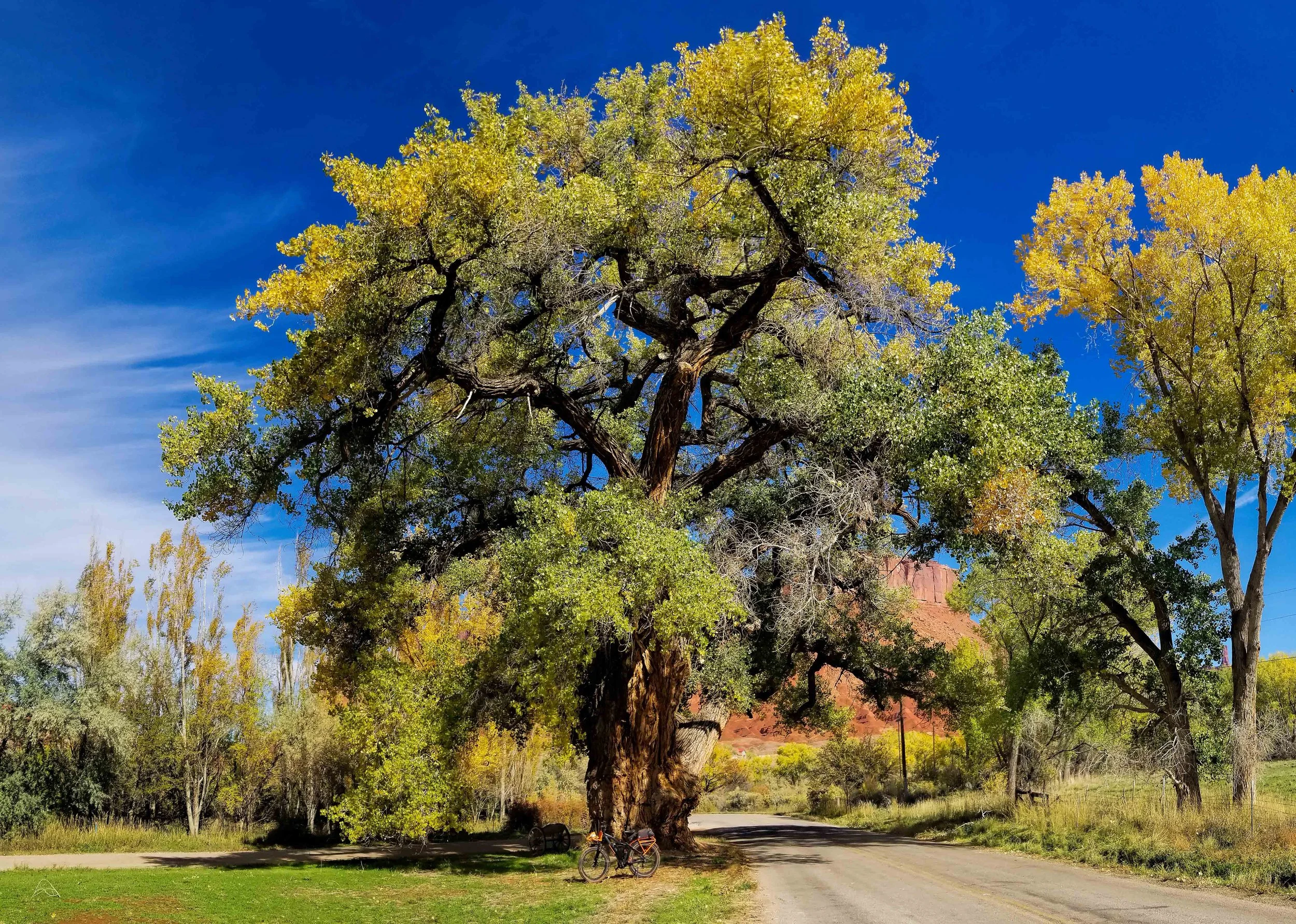
The woody behemoth on a beautiful autumn afternoon, estimated to be more than 130 years old.

This tree is even highlighted as landmark on Google Maps. It’s big!
X marks the spot...
above Castleton Tower this morning, targeting Castle Valley for chemtrail application today.


Afternoon update: You thought I was kidding. I got sprayed during my ride near Round Mountain.
Major changes on the trails...
from a series of recent rains, especially in the arroyos where erosion and sedimentation have reshaped the terrain.

FASSSSSSSSSSSSSSSSSSSSSSSSSST!
There’s no comparison between my former and new telecommunications providers at my high desert hacienda. See for yourself:

Out with the old: Frontier Communications DSL speedtest results.

In with the new: Emery Telcom fiber optic speedtest results.
Orders of magnitude performance increase on both download and upload speeds. WOW! But more than speed, the increased reliability of the fiber optic network is another important factor. Me likey.
The late bloomer...
in the high desert is a member of the sunflower family, and it’s at its peak brilliance right now. Absolutely radiant.

Rubber rabbitbrush (Ericameria nauseosa (formerly Chrysothamnus nauseosus)).
The water year...
is off to a good start in the La Sal Mountains of southeastern Utah, seen here freshly draped in snow from the season’s first winter storm. SNOTEL sites in the high country report 10, 12 and 13 inches of newly accumulated snow from yesterday.


Mostly cloud-free GOES-West satellite image showing snowpack in the Rocky Mountains after the winter storm.
Communing with bison...
in the Lamar Valley in the northeastern part of Yellowstone National Park. I spent an entire day observing about 500+ bison in several small herds, only about a tenth of the total estimated population in the park.

The majestic American bison (Bison bison).


Typical scene in Yellowstone: Always yield to a huge animal with horns when it decides to cross the road.

Lip-smacking good.

Time for a dust bath.

Catching a midday nap.
Heart Mountain...
is a beautiful and solitary peak (8,123 ft (2,476 m)) located north of Cody, Wyoming, the eroded vestigial remnant of an enormous slide block that was emplaced nearly 50 million years ago. A ~4 km thick sheet of rock about 1,300 square kilometers in area detached from the plateau to the west, sliding rapidly on a 2 degree detachment plane tens of kilometers towards the southeast into the Bighorn and Absaroka Basins. Heart Mountain is technically a klippe, and here’s more information about the largest terrestrial mass movement on Earth.

Sunrise behind Heart Mountain.

The summit block is composed of Paleozoic-age carbonate rocks, sitting on shale of the Willwood Formation that is 300 million years younger.
Autumn colors...
on the Fish Lake trail this afternoon, a signal for me to begin my migration south to red rock country.

Butterflies are in the air...

California tortoiseshell butterfly (Nymphalis californica) resting on a ponderosa pine tree.
Successful wet work...
in Puget Sound as team members for Apex Expeditions undergo a refresher course in the Standards of Training, Certification and Watchkeeping for Seafarers (STCW). The three day course in Edmonds, Washington covers water survival, fire fighting and medical training for individuals who crew vessels at sea.

Left to right: Peter Harrison, Shirley Metz and yours truly peeling off our Gumby-like full immersion suits after training in the cold water. (Image by Ingrid Nixon.)
Peter and Shirley are among the founders of Apex Expeditions and I am their go-to geologist during their worldwide travels. Peter has just published his extraordinary new book on seabird identification and Shirley was the first woman to ski to the South Pole from the edge of the continent in 1989.
Come travel with us! Apex Expeditions