from the sun with a plateau fence lizard, scaling the side of my high desert home.
Plateau fence lizard (Sceloporus tristichus).
from the sun with a plateau fence lizard, scaling the side of my high desert home.

Plateau fence lizard (Sceloporus tristichus).

has been constructed by bees and consists of a hard shell of sand grains cemented together by a waxy substance. I haven’t been very successful finding anything in the literature about this, and I will keep a watchful eye, especially next spring.

Cemented sand grains forming a casing, 2 x 3 cm in dimension, built and maintained by bees. The bee seen here is approximately 5 mm long.

Here’s a brighter macro shot with scale taken the following day of this amazing casing. It is located on the southern side of a small boulder in the rock garden, so it will be exposed to full sun through the winter.
UPDATE: Thanks to Dr. Harlan Gough for suggesting that this sandy cell has been constructed by a bee belonging to genus Dianthidium, or pebble bees.
on the first of October and nature delivers the first seasonal snow to the high La Sal Mountains just a day later. Winter is coming, but let’s enjoy autumn first.

over the La Sal Mountains early in the day, heralding a change in the weather that is predicted for the week ahead.


My metal Raven is in the vanguard of the gathering storm in the high country.
above Adobe Mesa this evening.


of cameras and telescopes as I continue to prepare for next month’s annular solar eclipse, experimenting with various manual exposure settings on two cameras and configuring a small refractor telescope for direct viewing. I’ll also create a time-lapse video of the event with a GoPro as well.

All of these instruments are outfitted with appropriate solar filters for direct viewing and/or photography of the Sun. IMPORTANT: Everyone will need appropriate eye protection for all phases of the eclipse, regardless of their location.

Today’s Sun captured by my Canon EOS 5D Mark IV with a Canon 400 mm telephoto lens and solar filter.

Image of today’s Sun from the orbiting Solar Dynamics Observatory for comparison.
More information about the 14 October 2023 eclipse: Eclipse America 2023.
go to the Grand County Road Department for a job well done eradicating graffiti on the Castleton Road bridge over Castle Creek earlier this year. I alerted them to the offensive tagging in May via email, and much to my surprise the director responded within hours asking for more information. He additionally followed up with another email in July informing me that the graffiti had been painted over. On behalf of all Castle Valley residents that enjoy this beautiful place, THANKS!

May 2023

September 2023
at 17.9 degrees away from the Sun, meaning it’s the best time to view the innermost planet before sunrise, while the Sun is still below the eastern horizon. Here is the tiny planet early this morning, rising above Adobe Mesa, with Venus shining more brightly overhead.

Heads up, the autumnal equinox is tomorrow. Bummer, I prefer longer days.
without me realizing it a few weeks ago. Since September 2020, over the last three years, I have ridden 10,188 miles, the cumulative mileage from my stable of eMTBs. That’s 41% of the Earth’s circumference! Yep. They’re big fun.

brightening the high desert landscape, many as tall as a person. It’s quite the display in Castle Valley and elsewhere.


The sun flares in these images are a result of closing down the camera’s aperture to its smallest opening. I manually set it at f/22 and make sure I have a very clean lens and shoot directly into the Sun. Easy.
using a new solar filter, all in preparation for the annular solar eclipse in one month’s time. I’m very excited.

My image captured early this afternoon with a 400 mm telephoto lens with solar filter (ND 100000).

For comparison, here’s the daily image from spaceweather.com with sunspot numbers, acquired by the Solar Dynamics Observatory.
More about the quickly approaching 14 October 2023 annular solar eclipse: Eclipse America 2023. IMPORTANT: Proper eye protection must be used to observe all phases of this event.
under extremely dark skies during the new moon the Milky Way is nothing less than sensational.


My camp along Mexican Mountain Road in the northern San Rafael Swell. I estimated that the core of the Milky Way would rise between Window Blind Peak (left) and Assembly Hall Peak (right). That’s the San Rafael River near the center of the image.

Silhouetted selfie with the Milky Way. All alone. Sublime.
ranks among my top five in Utah, and I visited it the second time this year as I dash into the San Rafael Swell for another night of astrophotography.

in the western Uinta Mountains of Utah is a moderate but rocky hike, and is also a lung buster if one is not acclimated to the high elevation. The trail steadily climbs 1,250 feet in 1.5 miles to the 11,943 foot (3,640 meter) summit where there are expansive views into four drainages.

Bald Mountain summit and Mirror Lake. Note the three hikers in the upper left approaching the summit plateau.

and very reliable, surging in 15 minute-long cycles of enormous discharge, then completely shutting down for a similarly long recharging period. This unusual and extremely rare hydrologic phenomenon is the outlet of a confined karst aquifer system hosted in the Madison Limestone. The intermittent spring lays in a deeply recessed canyon near Afton, Wyoming and requires a slow drive on a potholed gravel road and a short hike to reach.


Here is a well presented description of the spring, including an explanation of the mechanism at work: Geology of Wyoming - Periodic Spring.

Closer view of the modified spring orifice under flowing conditions. I recorded a time-lapse video of the spring over several cycles with a GoPro, tripod seen at left, and will post it here in a little bit.
UPDATED 19 September 2023: Here’s the time-lapse video of Periodic Spring through several cycles of discharge and recharge, each about 15 minutes long, shot over about 45 minutes. It’s magic!
next to Bald Mountain, high in the western Uinta Mountains of Utah. This new moon is the last opportunity to enjoy the galactic center this season, as it will not rise above the horizon in the northern hemisphere until next spring.

Silhouette of Bald Mountain (11,943 foot (3,640 meters)) on the right.

A frosty sunrise at Mirror Lake (10,050 ft (3,060 m)) the following morning.
supposedly comprise the world’s largest elkhorn antler arch in Afton, Wyoming. I didn’t take the time to count them.


at the edge of the Pintler Wilderness in Montana, my first stop on my drive south.

are my neighbor’s llamas, but they meet me at the fence line every day for a treat. I get all the enjoyment without any of the upkeep. Thought I’d snap a couple of quick portraits to share with their owner.


are triggering my migratory instincts as well. It’s about time to head south.
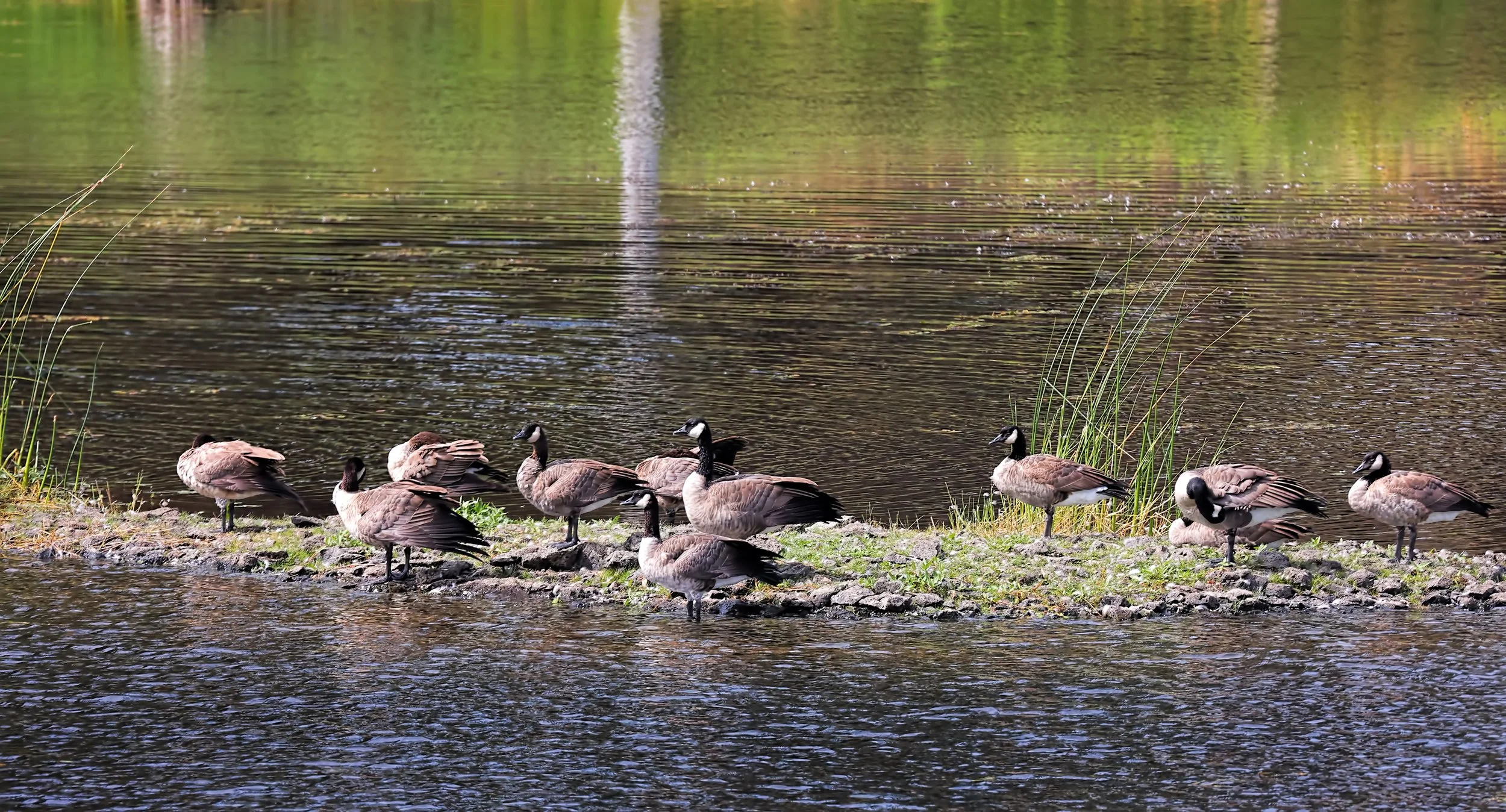
Canada Geese (Branta canadensis).