is being waged against this annoying woodpecker, determined to dismantle the cedar siding on my home.
Northern Flicker (Colaptes auratus).
is being waged against this annoying woodpecker, determined to dismantle the cedar siding on my home.

Northern Flicker (Colaptes auratus).
is a new game being played by my owl buddies. Looks like I need to get a kiddie pool for these characters.


These are cropped frames from the trail camera where time stamps show these two juvenile Great Horned Owls played together for 15 minutes. The diameter of the bird bath is two (2) feet (0.6 meters) for scale.
as I go about my early morning chores outside. It’s been like having my own pet owls the last month!
A very relaxed Great Horned Owl (Bubo virginianus). Click image to enlarge.
Standing sentry as the noon hour approaches. (Click image to enlarge.)

The regular pair, hanging out together mid-day.

by my presence on the back deck at dawn. Trail camera images showed that this individual spent nearly 30 minutes tromping around in the pool before it was disturbed. Here are a few:


Soggy Great Horned Owl (Bubo virginianus) glaring at me after abruptly exiting the bath.

Apres-preening siesta.
this vibrant giant blazingstar is especially colorful against the dark basalt.

Giant blazingstar (Mentzelia laevicaulis), about three feet (one meter) in diameter.

Blazingstar blossoms are large, about 3.5 inches (9 cm) across, and full of whisker-like stamens.
in the wetlands this morning, and a reminder that Thanksgiving is just around the corner. Here comes autumn.

Mallard or Wild Duck (Anas platyrhynchos).

Wild Turkey (Meleagris gallopavo).
to accommodate two Great Horned Owls at once! These two spent about 30 minutes together in the pool before retreating to a nearby perch to preen.


One GHO used the trail camera as a nearby perch before returning to the bath.

Right on time for a visit the following morning.
yields fragments of four (4) mouse skulls and a variety of long bones. Owls regurgitate undigested teeth, bones, fur and feathers in a single compact nugget, usually found on the ground beneath their favorite roosts.

Larger mouse bones found in a single owl pellet, with an undissected Great Horned Owl pellet on right. Plus two toothpicks for scale comparison.
I watched Chappie, my juvenile Great Horned Owl friend, spit up two of these bone-filled nuggets several days ago. He appears to be quite well fed.
this afternoon.
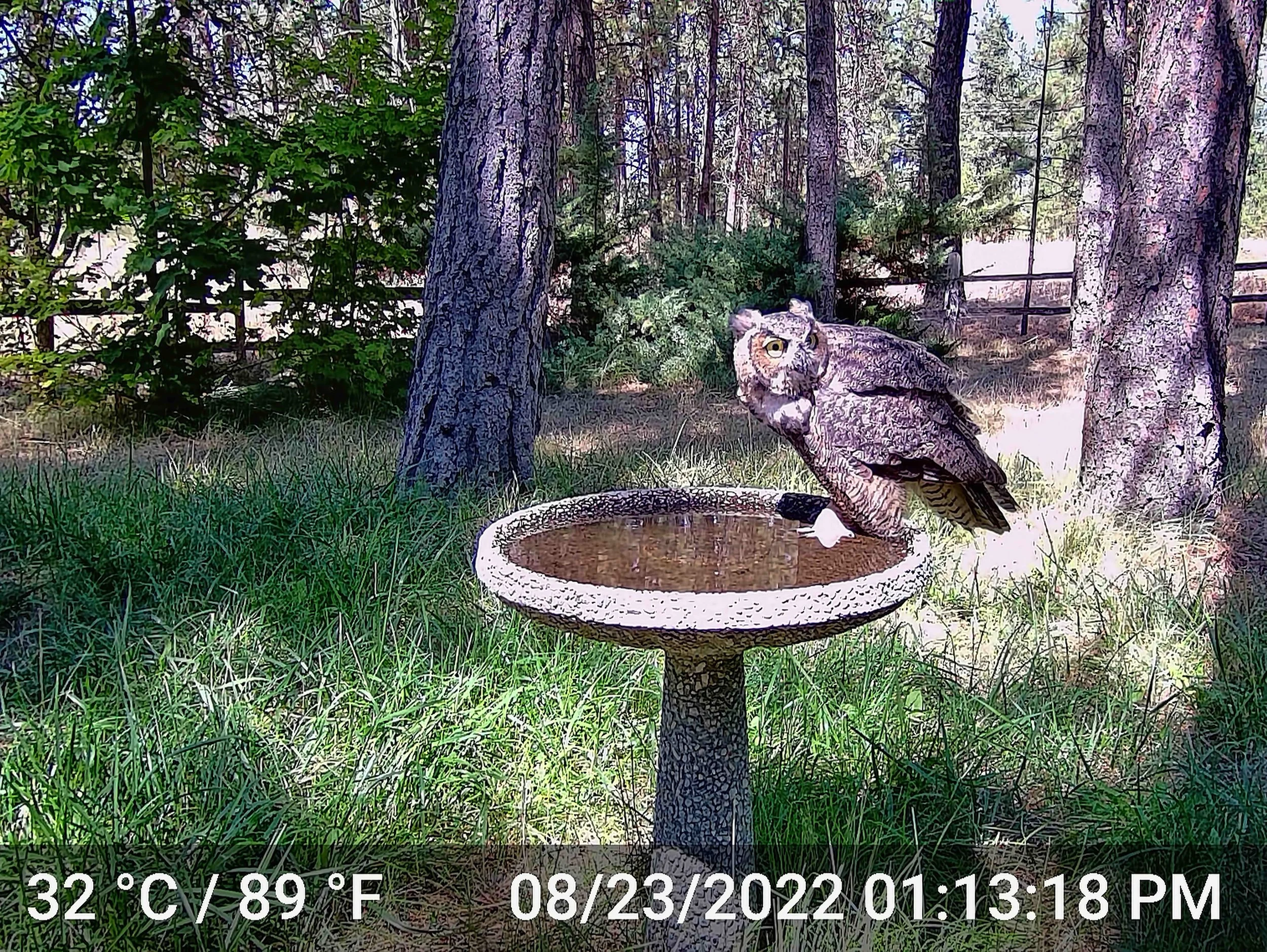

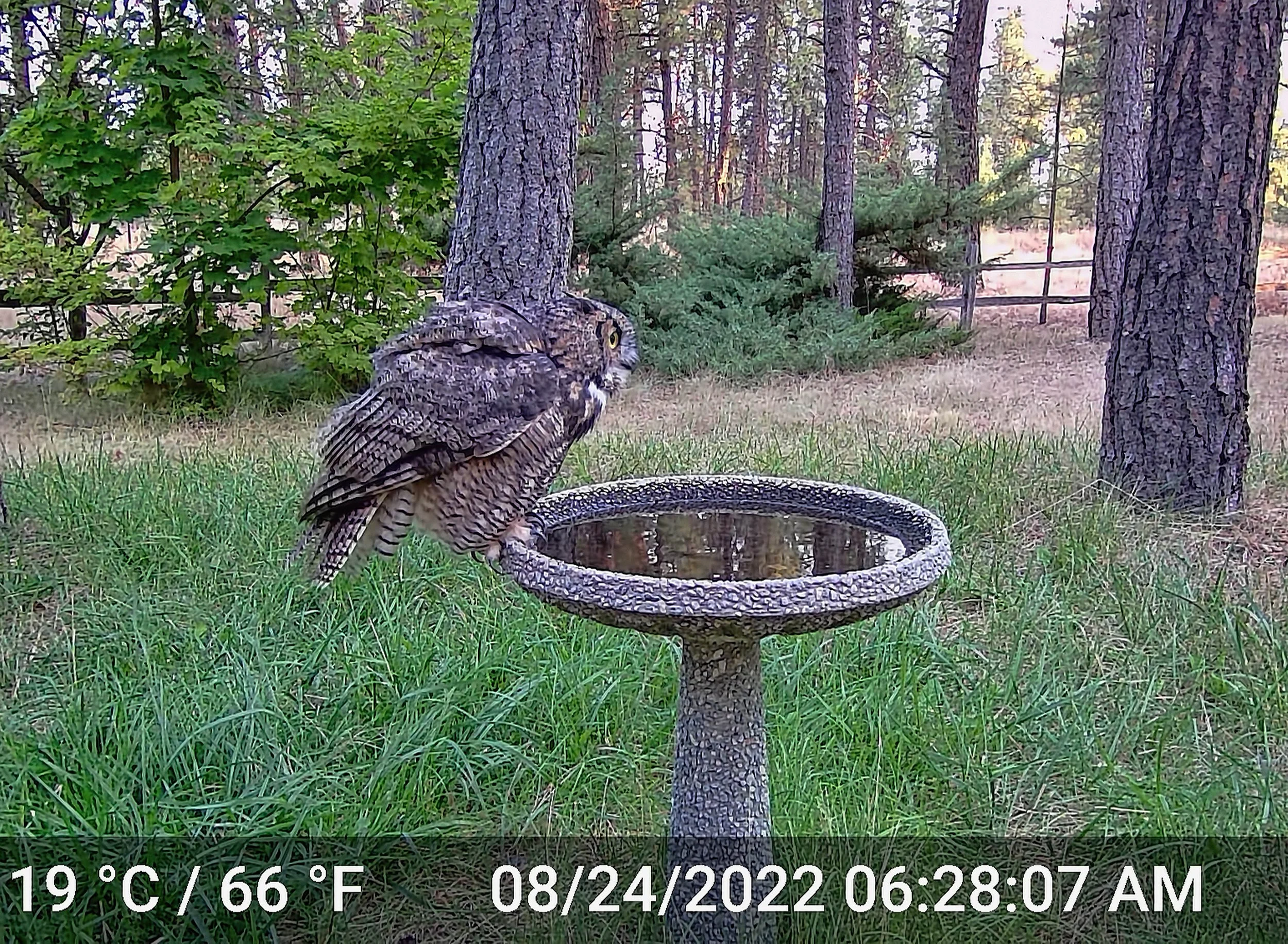
And another visit to the watering hole the following morning.
NOTE: The diameter of the bird bath is exactly two (2) feet (0.6 meters).
loom above a local grain elevator in eastern Washington this morning. Dramatic but ultimately harmless.

this week has hit the community hard, but it should not be entirely unexpected during summer monsoonal rain events. Two 100-year flood corridors converge in the heart of downtown - Pack and Mill Creeks - and flood hazard mapping shows that about 75% of the town’s center would be inundated. Increasing urban development and street-generated stormwater drainage probably exacerbated the situation.
FEMA’s flood hazard map for Moab, Utah. (Click on image to enlarge.)
Here’s more about the map shown above, including a legend and a zoomable viewer: Link to FEMA’s National Flood Hazard Service Center.
Fortunately there were no fatalities reported, just a lot of property damage. The cleanup: Image gallery at the Moab Times-Independent.
in the wetlands this morning, pretty well camouflaged among the cobbles. I count eight (8) individuals, not including reflections.

A group of juvenile Mallard Ducks (Anas platyrhynchos).


Note the size of their fully dilated pupils in this image caught under low light conditions at 5 am PDT.
Chappie from about a 20 foot distance. This individual owl is quite comfortable with my slow and close approach.
Juvenile Great Horned Owl (Bubo virginianus). (Click on image to enlarge.)

Later in the afternoon: Hey, mister, can I interest you in a wristwatch?
I’m shooting these owl images with my Canon EOS 5D Mark IV with the Canon EF 500 mm f/4L prime lens, handheld, at ISO 1600 in a shaded forest.
along the margin of Fish Lake this morning. Fortunately I was present and captured it with my camera.

Vagrant pink flamingo.

knows a good thing and can be reliably found on its perch above the birdbath nearly every morning. I absolutely love these magnificent creatures so I won’t apologize for posting too many photos.
Yet another image of a Great Horned Owl (Bubo virginianus). (Click on image to enlarge.)

Caught napping after my morning ride. I’ve been calling this one Chappie, because of the asymmetry of its hornlike tuft feathers.

Both my buddies, later in the afternoon. Their plumage is perfect camouflage against the bark of the ponderosa pines.
is seldom seen, so I’m glad it allowed me some snapshots this morning, even providing a toothy grin for the camera.

Yellow-bellied marmot (Marmota flaviventris).

is the Willow Goldfinch, a Pacific Coast subspecies of the American Goldfinch, so designated by the legislature in 1951.

Adult female Willow/American Goldfinch (Spinus tristis).

During this non-breeding time of year their plumage fades to a duller yellow.
that I increasingly believe are siblings, based on observing their behavior and listening to their vocalizations. They hang out here together, both in the morning and in the evening, often side-by-side on the same limb, sometimes interacting with each other with their talons. Interesting and amusing.

Great Horned Owls (Bubo virginianus).