is the official greeter as one enters the Town of Castle Valley. Respect his authority!
There seems to always be a controversy in the diverse community, hence the “Caution Falling Sky” sign!
is the official greeter as one enters the Town of Castle Valley. Respect his authority!

There seems to always be a controversy in the diverse community, hence the “Caution Falling Sky” sign!

Naked-stem sunray (Enceliopsis nudicaulis).

Dwarf lupine (Lupinus pusillus).
has been imaged by the Perseverance rover in the distant outcrops that mark the delta front in Jezero Crater on Mars. This is a clear indication of prograding (advancing) sedimentary deposits in water!


NASA's Mars Perseverance rover acquired these images using the SuperCam Remote Micro-Imager, located at the top of the rover's mast, on 24 April 2021 (Sol 63).

Diagram illustrating bedding relationships in a prograding Gilbert delta (from researchgate.net).
with the International Space Station zooming by high overhead early this morning around 4:50 am MDT. There are 11 ape-descendants onboard the ISS at present, the highest occupancy since it was assembled in orbit commencing in 1998.

Polaris (the North Star) is directly above Parriott Mesa and just a smidge beneath the path of the ISS. It’s the only bright star that isn’t slightly blurred in this nearly two minute-long exposure.
known as Castleton Tower casts its shadow on the north-facing slopes of Adobe Mesa, sweeping rightward each successive night, until it appears nearly below the prominent tip of the mesa at the time of the summer solstice.


Black-Chinned Hummingbird (Archilochus alexandri).

Showy four-o’clock (Mirabilis multiflora).

Mormon tea (Ephedra viridis).
in nearby Stearns Creek drainage. Here’s a wide panorama looking south:
Mars on Earth! Click on image to enlarge.

Annotated panorama. Left side is towards the east; Right side is towards southwest.
petroglyph panel is about two meters square, and likely depicts a snake dance ceremony.


Note the use of (faded) blue pigment on the eyes, on the snake in the mouth, and on the collar on the snake on the left.

Narrowleaf yucca (Yucca angustissima).
is an amazing and extraordinarily anatomically detailed pictograph located north of Moab. The panel shown below is about two meters wide and shows three anthropomorphic figures on the left and six birds laid out on the right.
This image was taken when the panel was fully shaded from the sun, and the brightness and contrast adjusted so that the details can be seen more easily. (Click on the image to enlarge.)

Nearby petroglyphs on a desert varnished sandstone surface.

Bighorn sheep petroglyphs.
sits beneath Convent Mesa, on the far right, in the image immediately below. Three of the four sides of the nearly cubic block are adorned with dozens of petroglyphs, two of which are included here, each about 30 cm across.


Early local explorer Mat A. Martin inscribed his name on the deeply shadowed eastern side of the block. Width of view is about 1.5 meters.
this morning, with what I believe are two males vying for the attention of a single female. I’ll be watching and shooting in the weeks to come!




at the feeding station this afternoon. I’m positive it can fit more seed in its cheeks!


A well fed rock squirrel (Otospermophilus variegatus).
is just one of an estimated 20,000 species belonging to the family Tenebrionidae.

Darkling beetle approximately 2 cm long.
to the Castle Valley community and I eagerly welcome it to my digital diet way out here in the middle of gorgeous nowhere.

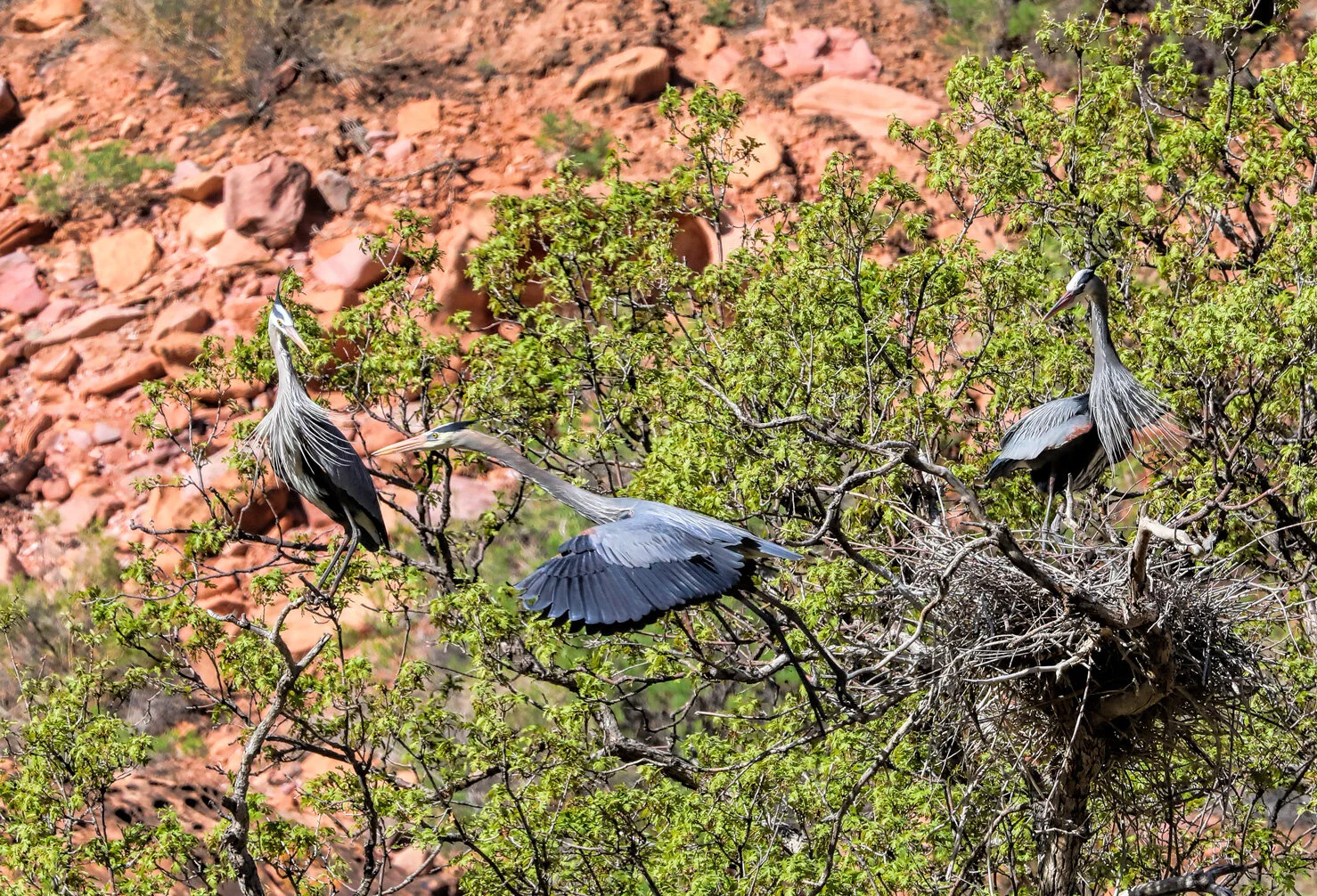
the Great Blue Herons returned to their rookery on the Colorado River. Guess who showed up today?

Great Blue Heron (Ardea herodias).
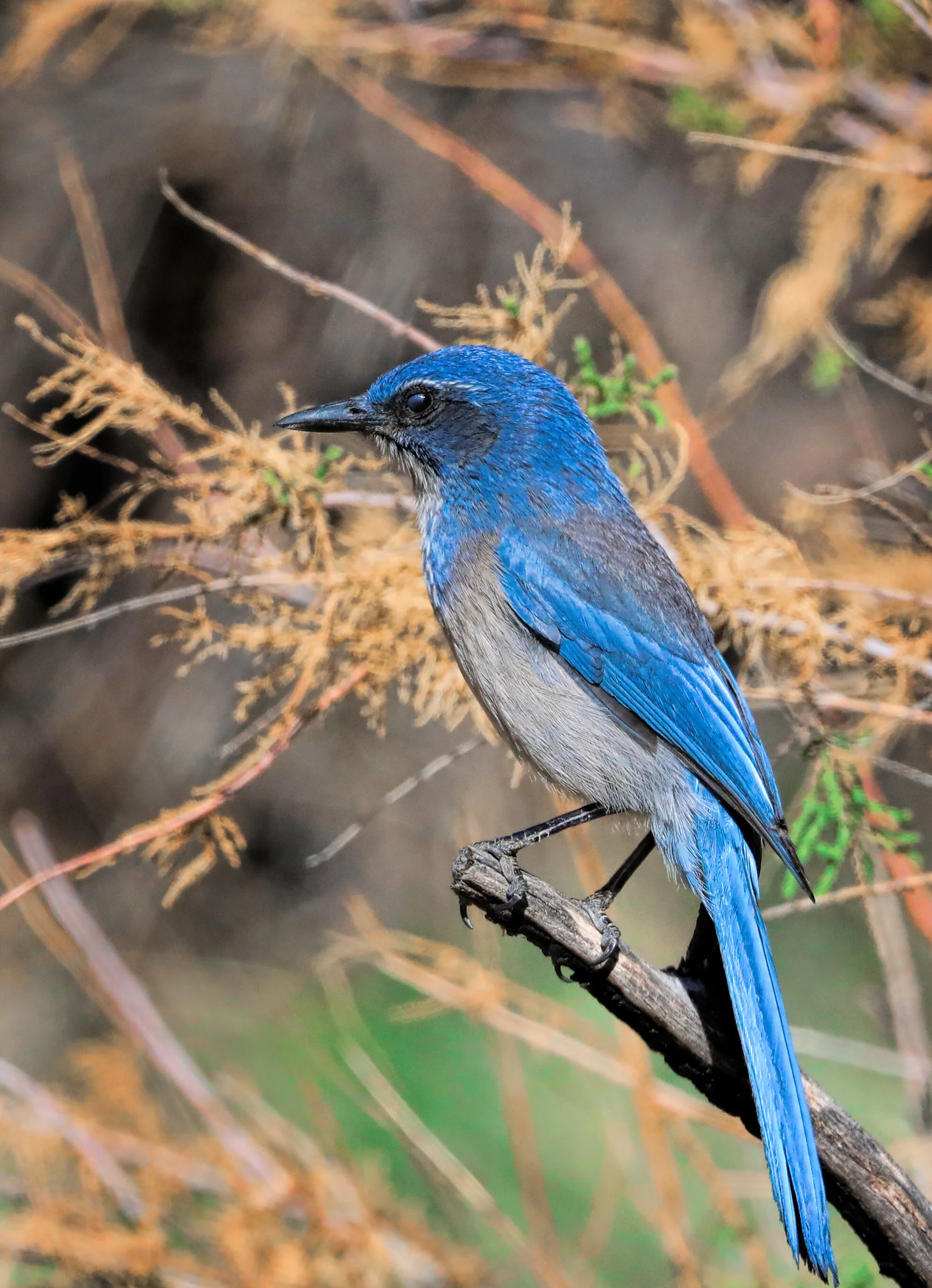
Bonus picture: Western Scrub-Jay (Aphelocoma californica).

Double bonus pic: Spotted Towhee (Pipilo maculatus).
Do you have any idea how difficult it is to get all the birds to pose calmly and look in the same direction?!
join the spring bloom along the Colorado River.

Fendlerbush (Fendlera rupicola).

Fremont’s Mahonia (Mahonia fremontii) is also wonderfully aromatic.
by two Canada Geese above the Colorado River.

Canada Geese (Branta canadensis).
is marked by this heap of aspen wood waste, all that remains from a shingle splitting operation that existed on this site. The locals in Castle Valley refer to the nearby irrigation pond as the Quakie Shake pond in recognition of this little bit of history.

