setting above Porcupine Rim this evening. Seventeen days to go until the winter solstice.

Adding a bit more insulation...
to the winter nest as nighttime temperatures fall below freezing.

Female House Sparrow (Passer domesticus).
Meanwhile, another flashy little sparrow works the feeding station.

Dark-eyed Junco (Junco hyemalis).
Standing at the vanguard...
of our bucolic high desert community, Smokey the Bear wishes everyone a happy Thanksgiving and a safe holiday season. We are all very grateful and sleep better at night knowing that Smokey is tirelessly on the job.

In constant orbit around the house...
while patrolling the various feeding stations, this bird of prey knows where the Horn of Plenty occurs in Castle Valley.

Sharp-shinned Hawk (Accipiter striatus).

An outstanding early start...
to the water year in the high country thanks to a pre-Thanksgiving winter storm that dropped 1.5 inches (38 mm) of rain on Castle Valley yesterday.


SNOTEL time series showing this year’s snowpack (black line). Green line represents the median and the orange line is the previous water year for comparison.
Link to NRCS Snotel network.
Seemingly constantly hungover...
with its bloodshot red eyes, this large, striking sparrow is one of my favorites at the feeding station.
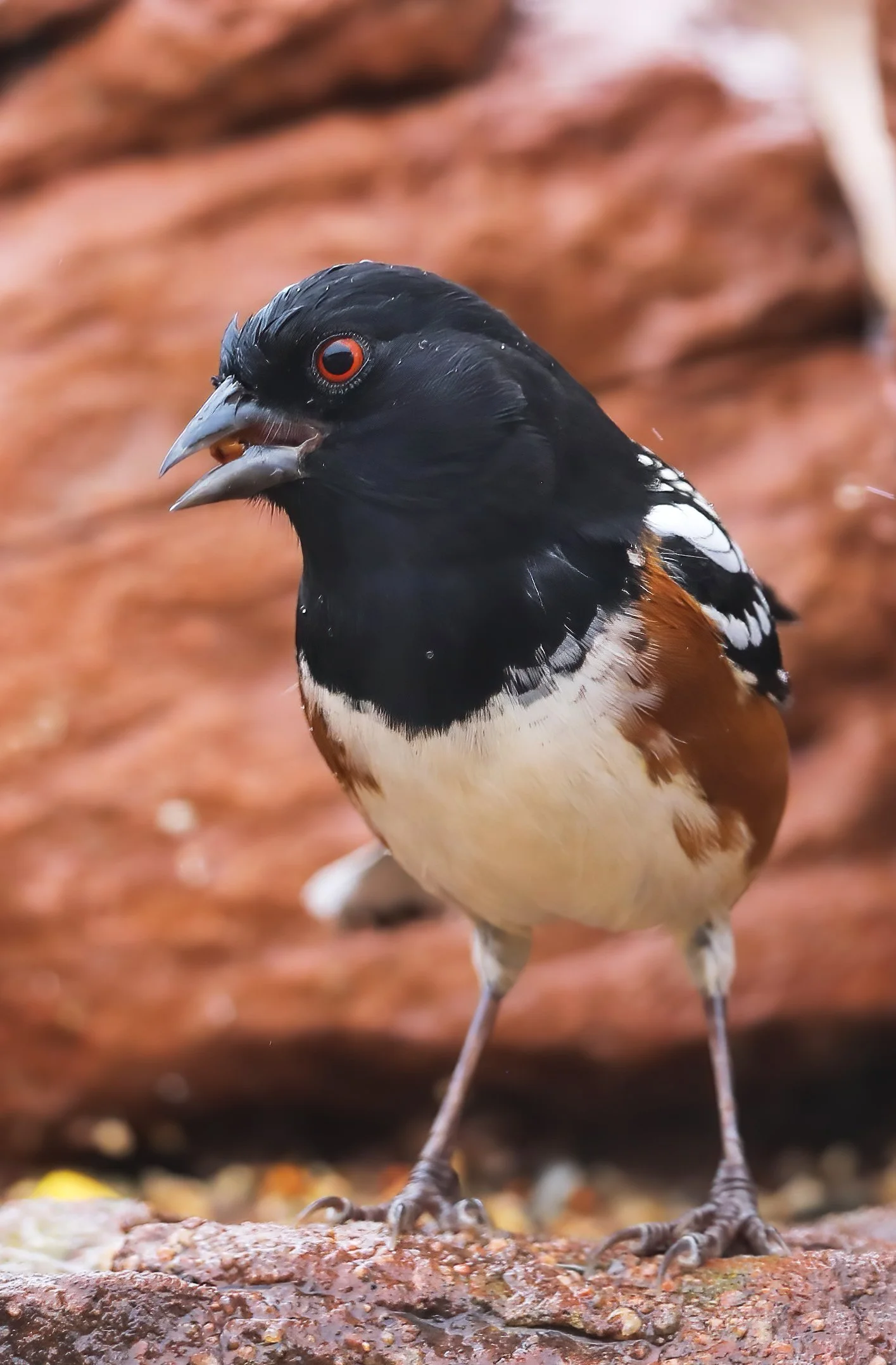
Spotted Towhee (Pipilo maculatus).

Plucked as clean...
as an upcoming Thanksgiving turkey, this cow carcass has been laying out on the range for only about two weeks. There are some well-fed wildlife at Round Mountain this holiday season.

A warm pre-dawn glow...
reflected by clouds above the La Sal Mountains slowly expanded and flared to a vibrant display across the southeastern sky early this morning. Wow.


A regular evening ritual...
is developing where a small herd of muleys pays a visit to the birdbath. First come, first served.

Mule deer (Odocoileus hemionus).
Look who's lurking in the rabbitbrush...
with its head on a swivel, scanning for a free meal this afternoon. This is the second pass today at the fly through buffet.
Sharp-shinned Hawk (Accipiter striatus).

Note the different sized pupils, or anisocoria, due to the difference in lighting.
The latest addition to the guest list...
at the feeding stations this season is the usually melodic Western Meadowlark, though not very vocal this time of year as they are in the spring. But always dressed smartly for dinner.

Western Meadowlark (Sturnella neglecta).
A powerful symbol...
in mythology and folklore, this large and intelligent bird is checking out the feeding station this sunny afternoon. Quite the handsome bird.

Common Raven (Corvus corax).

Creepy: The nictitating membrane is a transparent or translucent third eyelid, caught in the closed position over the eye in this high-speed image.
Setting Full Beaver Moon...
above Porcupine Rim early this morning. The final supermoon of the year.

With clockwork precision...
the nearly full Moon rises next to Castleton Tower. Tomorrow night’s Full Beaver Moon will be the last of three supermoons for 2024. Enjoy.

The high country...
above red rock canyon country is getting dressed for the coming winter.

Rabbitbrush seeds are on the menu...
for breakfast this frosty morning.

American Goldfinch (Spinus tristis).
The winter launch campaign commences...
with the Arcas model sounding rocket, seen here lifting off on a beautiful sunny morning from the driveway.

Accompanied by a cloud of smoke and a whoooosh, Arcas soars off the rod to an apogee of 488 feet on a standard “C” engine.
In a blur of motion...
this young bird of prey failed to strike its intended target that fled into the saltbush. It’s using my feeding stations to hone its hunting skills and I’ve got my camera ready.

Sharp-shinned Hawk (Accipiter striatus).


One hundred million years of Earth history...
is exposed in the strike valley below Castleton Tower, seen below in this geologically annotated image that includes the formation names and ages (Ma = mega annum = millions of years). The tilted beds of the Cutler Formation (right) comprise the northeastern limb of the Castle Valley salt anticline.
View toward the southeast with Adobe Mesa in the distance. (Click on image to expandify.)
Yes, it was another terrific afternoon for a bike ride in Castle Valley National Park.
Weekend rains translate to mountain snows...
in the La Sal Mountains, with snow level occurring at about 7,200 feet (~2,200 meters). It’s too early for the SNOTEL network to yield any seasonal information on snow depth and water content in the high country.
