visits this evening at dusk.
Great Horned Owl (Bubo virginianus).
visits this evening at dusk.

Great Horned Owl (Bubo virginianus).

in eastern Washington where the Gray Fire erupted two days ago, burning more than 10,000 acres and destroying more than 185 homes and structures in and around the community of Medical Lake. A “State of Emergency” has been declared in Spokane County and my residence is under a Level 2 (Get Set) evacuation order.
Current information here: Watch Duty - Gray Fire.
Fire mapping: Fire Information for Resource Management Systems US/Canada.

Image by C. Pritchard taken on 18 August 2023 from northeastern shore of Medical Lake.
UPDATE 22 August 2023: A burn perimeter map has been released showing the affected 10,014 acres with the ignition source located at a youth ranch west of Medical Lake. My residence still remains in a Level 2 (Get Set) evacuation status. Rain is in the forecast!

Gray Fire burn perimeter map southwest of Spokane, Washington.
UPDATE 22 August 2023 at 5 pm PST: Evacuation areas are being downgraded and my residence is no longer under any evacuation warning. Feeling extraordinarily fortunate.
will traverse the southwestern United States in about two months time. I’m getting prepared for this rare and interesting astronomical event, the center line for which is a short distance south of Moab, Utah. I’ll be camping there with all my telescopic and photographic gear.

More information here: Eclipse America 2023.
Terrific zoomable map: Interactive Google Map showing center line.

IMPORTANT: All observers regardless of location will require appropriate eye protection to view this event!
caught at the bird bath by the trail camera last evening following a very hot day.

Great Horned Owl (Bubo virginianus).

Days later: Elusive during the daytime, but a frequent visitor under the cover of darkness.
at the leading edge of the wind driven wildfire. I estimate that only about 40 acres of ponderosa pine forest burned, thanks to the quick aerial response in dousing the fire.

hiding in the dry grass.
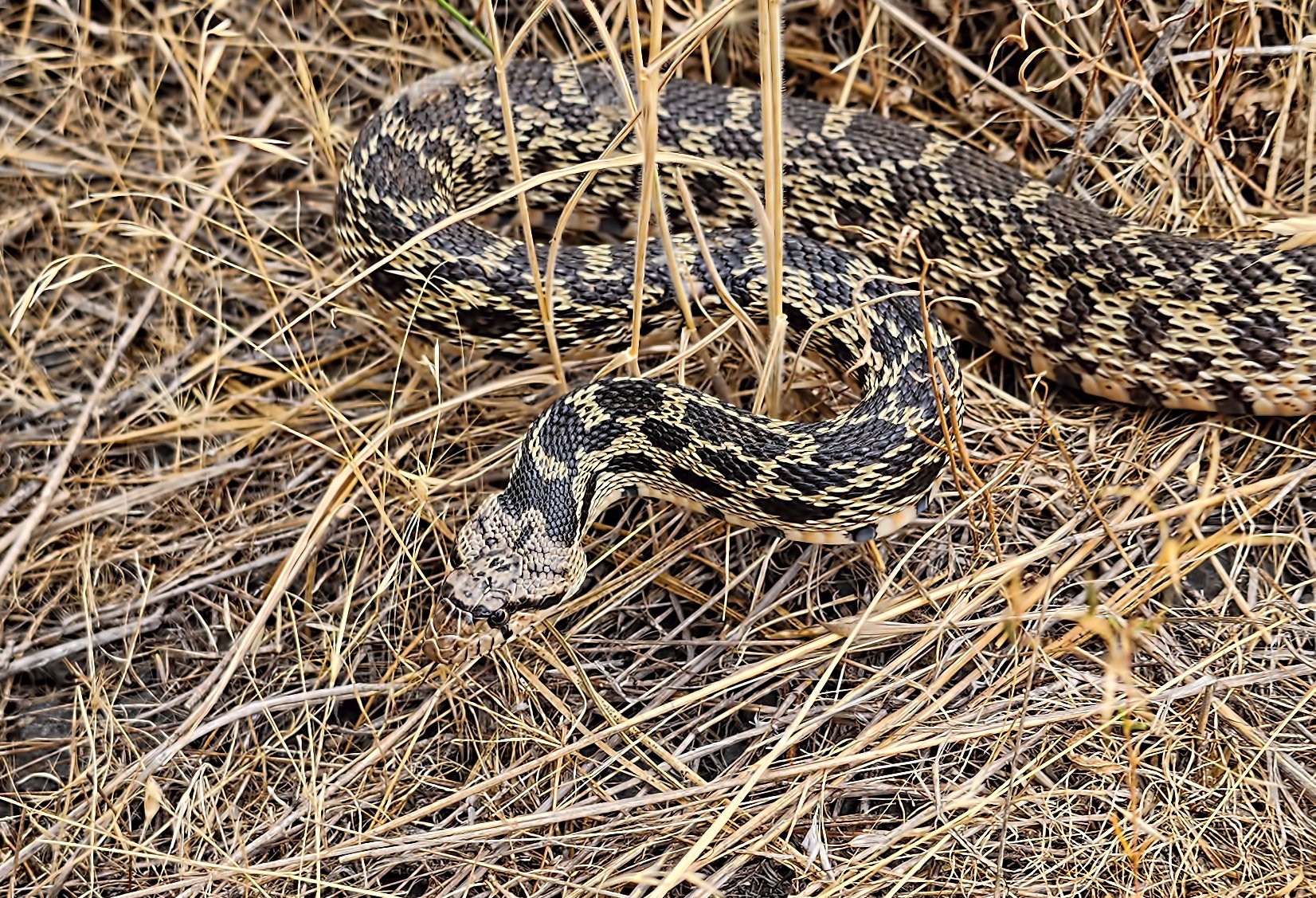
Bullsnake (Pituophis catenifer sayi).
darkened by carbon black and soot are keeping a watchful presence on the recent nearby wildland fire, managing several pumps and a tangle of fire hoses. I thanked them profusely for their hard work on behalf of the local community. Fortunately rain is in the near forecast.

Cheerful fire crew from Eastside Fire and Rescue, Issaquah, Washington.

Walk your bike! Fish Lake Trail near Spokane, Washington.
flared up this evening east of town, likely due to sparks along the railroad, with local firefighters and aerial crews immediately attacking the fast spreading fire. I snapped these images with my smartyphone camera on the trail, then retreated for a wider view.


Four AT-802F Fire Boss aircraft attack the fire with several helicopters and a spotter plane in support.


The day after: Still smoldering pine duff at the southwestern edge of the fire margin. The trail is closed and crews are still on site.
is modeled in metal, but at a considerably larger scale.

Pygmy Nuthatch (Sitta pygmaea), both foreground and background.
Unsponsored plug: If you’re a bird lover, check out Metalbird.
of the asphalt surface of the bike trail, this smart reptile enjoys a few moments at sunset.

Common gartersnake (Thamnophis sirtalis).
on the wildlife-rich Fish Lake Trail this morning.

Mule deer doe with two fawns (Odocoileus hemionus).
of the Fish Lake Trail by a crew from Washington State Parks, yet the hazard of rock topple still remains along this short stretch of passage.

Site in early July 2023, but the rockfall occurred during winter or spring.

Site today following cleanup of fallen debris on the trail. One leaning basalt column remains.

A soft, sedimentary interbed lies below the columnar-jointed basalt lava flow unit and is considerably more erodible. The excavation of the railroad cut in the early 20th century exposed the contact and this will likely have to be maintained in perpetuity. Trail users beware!
were underway late this morning, with Minnie, the mamma Mallard, coaching on the sidelines.

Mallard Ducks (Anas platyrhynchos).
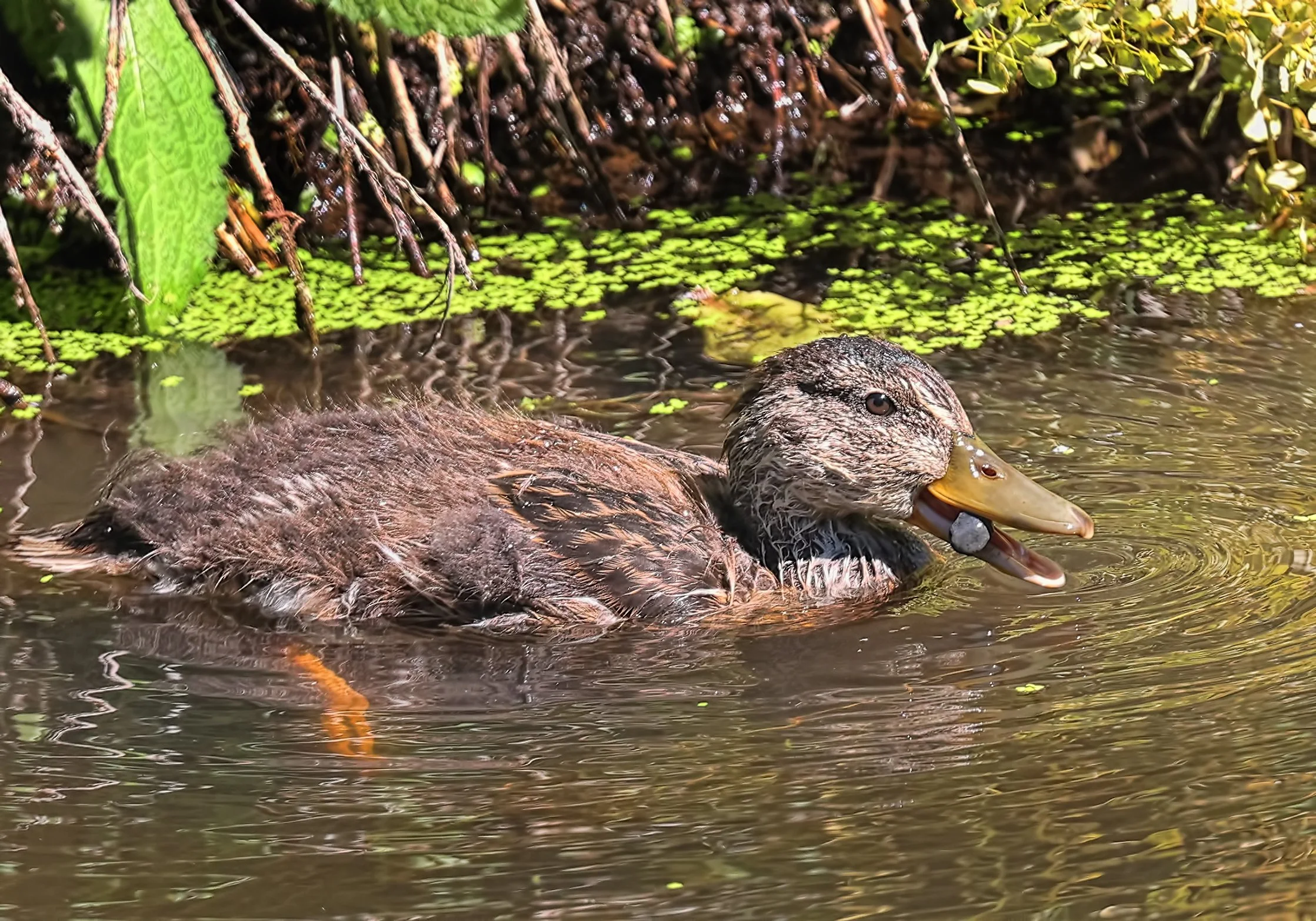
Look ma, got something!
for the camera is an absolutely impossible task.

A grumpy painted turtle (Chrysemys picta).

in the creek while Mom keeps a watchful eye nearby.

Mallard Duck chick (Anas platyrhynchos).

This is the mamma Mallard, named Minnie.
on the Fish Lake Trail this morning! Huge and magnificent beast!
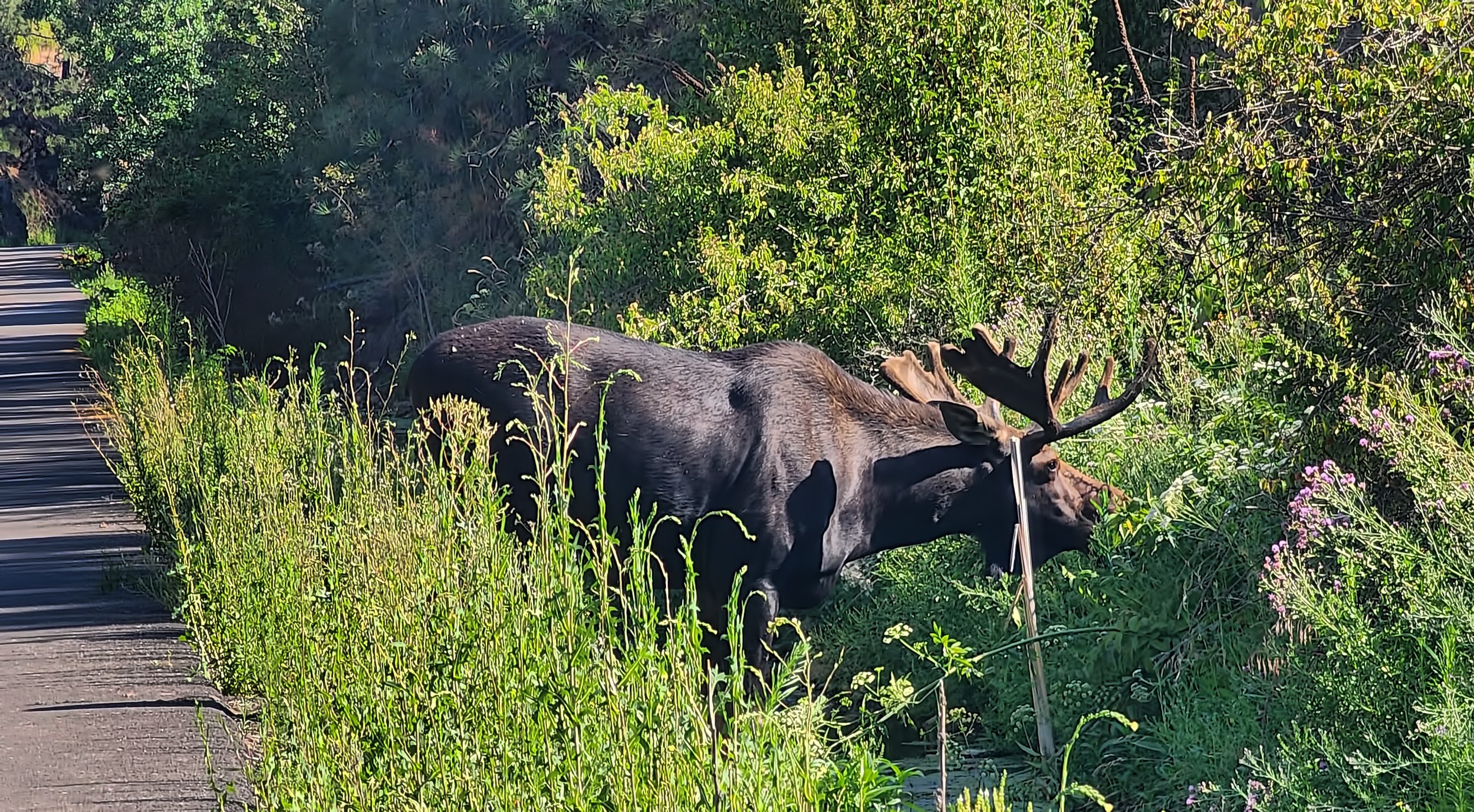
Bull moose (Alces alces).

These snaphots were made with my smartyphone camera from about 35 yards/meters away.

Mallard or Wild Duck (Anas platyrhynchos).

Happy duckling!
carrying breakfast back to the family burrow early this morning along Minnie Creek. Quite amusing to observe as it calmly paddled by on its mission.

Muskrat (Ondatra zibethicus).
early this morning. Its blooms slowly march up the tall stem through the summer, reaching the apex as the first frost approaches. Looks like we have a while to go.

Fireweed (Chamaenerion angustifolium), also known as great willowherb north of the border.
was in use by the operators of the Spokane, Portland and Seattle Railway Company in the early 1900s to guard against rockfalls spilling onto the tracks and causing an accident. A series of electrified wires were strung along the more unstable sections of the rock cuts in the columnar basalts that are prone to toppling. Should the circuit be cut it would potentially indicate that a rock had severed the wire. Some relics of this system remain along the paved trail in the form of standing poles, some with insulators. The line was abandoned by the railroad in 1987 and eventually incorporated into the Columbia Plateau State Park Trail.

Location of a recent rockfall onto the paved trail. The vertical spacing of the insulators suggests a series of parallel wires, strung pole to pole, along the length of a cut.
